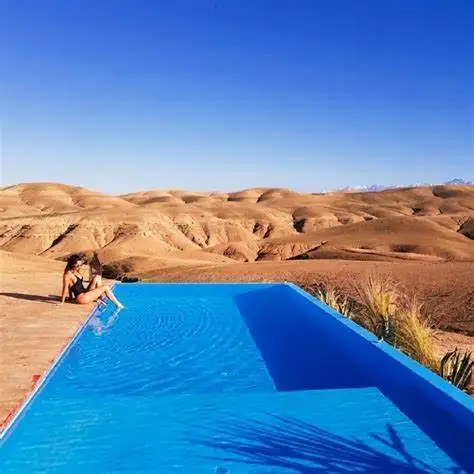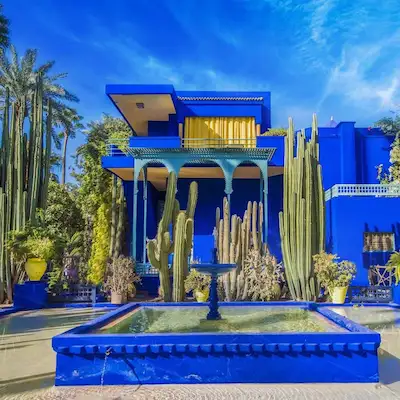
The Short Answer
For a first trip to Marrakech, stay in the Medina — the walled old city — ideally in the calmer southern part around Riad Zitoun and the Kasbah. It puts the souks, Jemaa el-Fna and the great monuments within walking distance, and waking up inside the old city is the entire reason to come here.
Pick a different base only if you have a specific need: Gueliz for restaurants, shopping and a calmer, European pace; Hivernage for five-star hotels, spas and nightlife; Palmeraie for resort pools, gardens and space for families. Below, I walk through all four the way I do for my own guests — what each is really like, who it suits, and the mistakes I watch people make.
"Where should we stay in Marrakech?" is the question I am asked more than any other — more than what to see, more than what to eat, more than how to get to the desert. And it matters, because Marrakech is not one city. Within ten minutes of each other sit a medieval walled medina, a French colonial new town, a glossy district of nightclubs and spas, and a palm grove of walled resorts. Choose the area that matches the trip you actually want, and almost everything else falls into place. Choose the wrong one, and you spend your holiday in taxis, mildly disappointed and not sure why.
This is the guide I wish every visitor had before they booked. I am not selling you a hotel and there are no affiliate links pushing you toward whoever pays the most. I run transfers and tours across Morocco, I collect travelers from these neighborhoods most weeks of the year, and I hear what they loved and what they would change when I drive them back to the airport. What follows is the neighborhoods of Marrakech — the Medina, Gueliz, Hivernage and Palmeraie — explained honestly, matched to the kind of traveler you are, with a comparison table, the common mistakes, and the corners only locals tend to mention.

Decide your neighborhood before you fall in love with a specific hotel photo. The area sets the whole rhythm of your day — how you get to dinner, how far the taxi has to go, whether you wake to birdsong or to the souk. Get the area right and almost any decent place inside it will make you happy. Get it wrong and even a stunning property feels like a chore to reach.
What's in this guide
- Best area to stay for: first-timers, families, luxury, nightlife, budget & authenticity
- An overview of Marrakech's neighborhoods
- The Medina — the heart of the old city
- Gueliz — modern Marrakech
- Hivernage — luxury hotels & nightlife
- Palmeraie — resorts, palms & calm
- Agdal — the quiet, modern new district
- Compare the neighborhoods at a glance
- Common mistakes when choosing where to stay
- A Marrakech resident's recommendations
- Frequently asked questions
Best area to stay in Marrakech for…
Most people arrive with one specific version of the question — "where do we stay as a family?" or "where's the nightlife?" So before the long descriptions, here is the quick version: my single best-area pick for each kind of traveler. Each one is explained in full further down the page.
Around Riad Zitoun and the Kasbah — walk to everything iconic, but calmer than the main square. The classic, can't-go-wrong choice.
The Palmeraie for big pools and space to run; Gueliz for a modern hotel with a lift, close to easy restaurants and parks.
Hivernage for five-star hotels and spas; the Medina for the world-class riads — the Royal Mansour, La Mamounia and grand restored houses.
An intimate courtyard riad with a candlelit rooftop is the city's most romantic stay; for a honeymoon hideaway, swap it for a private-pool villa in the Palmeraie.
The clubs, lounge bars and late restaurants are here, with Gueliz next door for wine bars and a more relaxed evening out.
The best value in the city — beautiful budget riads with courtyards and rooftop breakfasts from around €35, in the most exciting part of town.
The northern medina, Dar el-Bacha and the Mellah are residential and real — daily Moroccan life, fewer tourists, lovely riads.
You will notice the Medina appears again and again. That is not laziness — it is genuinely where most visitors are happiest, and the reason becomes obvious once you understand how the city is laid out.
An overview of Marrakech's neighborhoods
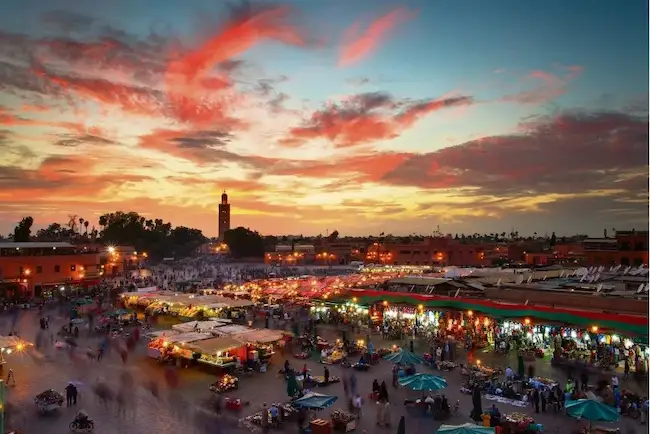
To choose well, it helps to picture the shape of the city. Marrakech grew from the inside out. At its center is the Medina, the old walled city founded almost a thousand years ago — a dense, tawny-pink maze of alleys, souks, mosques and palaces, ringed by ramparts and punctuated by grand gates called babs. This is the Marrakech of the postcards, and it is where the famous square, Jemaa el-Fna, beats like a heart every evening.
When the French arrived in the early 20th century, rather than build inside the old city they laid out a new town beside it: Gueliz, with straight boulevards, cafes and a European grid. Just south of Gueliz, between the new town and the medina walls, is Hivernage — once a garden district of winter villas, now the address of the city's biggest hotels, spas and nightclubs. And several kilometers to the north-east, beyond the ring road, lies the Palmeraie, an ancient palm grove now dotted with walled resorts, golf courses and private villas.
Those are the four you actually choose between, and they cover the vast majority of visitors. There is a fifth district worth knowing for longer or repeat stays — Agdal, the quiet, modern quarter spreading south along Avenue Mohammed VI — which I cover in its own section below. (Design hunters also occasionally base themselves around the concept hotels of Sidi Ghanem, the city's industrial-chic zone, but it's a niche choice.) Here is the at-a-glance version of the main four before we go deep on each.
The Medina
Atmospheric · historic · intense- Souks, monuments & Jemaa el-Fna on your doorstep
- Where almost all the beautiful riads are
- Best value, from budget to royal
- Cars can't reach most doors — you walk the last stretch
- Sensory overload; easy to get lost at first
Gueliz
Modern · relaxed · European- Wide pavements, restaurants, cafes & boutiques
- Taxis reach your door; the most walkable district
- Modern hotels with lifts and full-size pools
- Few real riads — mostly hotels and apartments
- A 10-15 min taxi from the old city
Hivernage
Polished · upscale · nightlife- Five-star hotels, spas, rooftop bars & clubs
- Leafy, quiet, orderly streets
- Walk to Gueliz, short ride to the medina
- Almost no riads — this is hotel territory
- Polished, but not "Moroccan" in feel
Palmeraie
Tranquil · green · resort- Palm-grove calm, big gardens & large pools
- Villas and resorts with real space
- Wonderful for switching off and for kids
- 15-25 min from the medina — you taxi everywhere
- You see the resort, not the city; transport adds up
How far apart are they, really?
Marrakech is compact. From the heart of the Medina, Gueliz and Hivernage are a 10-15 minute taxi ride (roughly 20-40 MAD by day), and the Palmeraie 15-25 minutes. Nothing is far — but those short rides add up over a week, and they are exactly why your base matters. Walk-everywhere days versus taxi-everywhere days come down to this one choice.
The Medina — the heart of the old city
If Marrakech has a soul, it lives inside the ramparts. The Medina is a UNESCO World Heritage site and a living, working medieval city all at once: donkeys and handcarts in alleys too narrow for cars, the hiss of a tagine through a doorway, dye-stained wool drying on a roof, the muezzin's call rolling over the rooftops five times a day. At its center, Jemaa el-Fna fills each evening with orange-juice carts, storytellers, musicians and food stalls — chaotic, theatrical, and utterly unlike anywhere else on earth.
Staying here means staying in a riad, the traditional courtyard house that turns its back on the street and opens inward onto a tiled patio with a fountain and orange trees. From the alley you see only a plain wall and a studded door; step through and the city noise drops into cool, green silence. It is the single most distinctive way to sleep in Marrakech, and for a first visit I recommend it almost without exception. (If you want my specific property picks, I've written a separate honest guide to the best riads in Marrakech.)
The atmosphere
The Medina is immersive in a way no other district is. You do not visit the old city from here — you live in it. Breakfast comes to a rooftop with views over the rooftops to the snow-capped Atlas; you step out of your door and you are already in the story, three minutes from a 16th-century palace and five from the souks. It is intense, romantic and endlessly photogenic. It is also loud, crowded and disorienting at first, and that contradiction is the whole point: the Medina rewards travelers who want to be in it, not insulated from it.
Advantages
- Walk out of your door into the real old city — souks, monuments, Jemaa el-Fna
- Where the beautiful riads are, at every price from €35 to €1,000+
- The best value in Marrakech for atmosphere per dirham
- Rooftop breakfasts and Atlas views you'll remember for years
- The most "Marrakech" experience there is — this is why you came
Disadvantages
- Cars can't reach most riad doors; you walk the final alleys, sometimes with a porter
- Easy to get lost — the alleys are unmarked and unlit at night
- Touts, persistent vendors and scooters in the lanes can be tiring
- Noise near Jemaa el-Fna or a mosque (the dawn call to prayer)
- Old houses mean steep stairs, no lifts and characterful plumbing
Which corner of the Medina?
The Medina is not one place — it has neighborhoods of its own, and the difference is real once you are dragging a suitcase at midnight.
- Around Jemaa el-Fna: ultra-central and thrilling, but the square's noise carries and the alleys are at their busiest. Great for a short, in-the-thick-of-it stay; tiring for a long one.
- Riad Zitoun & the southern Medina: my default recommendation. Ten to fifteen minutes' walk from the square, steps from the Bahia Palace and the Saadian Tombs, yet noticeably calmer — the best balance of access and sleep.
- The Kasbah: the old royal quarter in the south, quieter still, near El Badi Palace, and easier for taxis to reach the edge of.
- Dar el-Bacha & the northern Medina: residential, authentic, home to some of the loveliest riads — but a 15-20 minute walk to the square and easier to get lost in.
- The Mellah (old Jewish quarter): full of history beside the spice market and El Badi, with fewer tourists and a strong sense of everyday local life.
Choose a riad near a gate (a "Bab") rather than one buried deep in the souks. On arrival day — jet-lagged, with luggage — the difference between a two-minute walk from the taxi drop-off and a fifteen-minute hunt through dark alleys is enormous. You can always wander deeper into the maze once you've found your feet. And whatever you do, learn the name of your nearest bab; it's how every local will guide you home.
For a deeper walk-through of the old city — how it's organised, gate by gate, and how to navigate the souks without getting lost — see our dedicated Marrakech Medina guide.
Gueliz — modern Marrakech
Cross the wide Avenue Mohammed V from the medina walls and you step out of the medieval city and into the 20th century. Gueliz (pronounced geh-LEEZ) is the ville nouvelle, the new town the French laid out a hundred years ago: a grid of palm-lined boulevards, pavement cafes, art galleries and apartment blocks. This is where middle-class Marrakchis actually live, work, shop and dine — and increasingly where savvy repeat visitors choose to base themselves.
It is the antidote to medina intensity. Here there are pavements you can walk three abreast on, pedestrian crossings, street lighting, supermarkets and pharmacies, and taxis that pull up to your actual door. After a couple of sensory-overload days in the souks, many travelers are surprised by how much they enjoy the simple ease of Gueliz: a flat white in a sunlit cafe, a glass of Moroccan wine with dinner, a quiet, modern hotel room with a lift and a real pool.
Restaurants & cafe culture
Gueliz is the city's best district for eating and drinking, with a range the medina simply can't match. You'll find proper Italian and French bistros, sushi, modern Moroccan, brunch spots and specialty coffee, plus institutions like the long-running Grand Café de la Poste. Crucially — unlike most of the medina — a lot of Gueliz restaurants are licensed, so a bottle of wine with dinner is easy. Café culture is real here: locals linger over mint tea and people-watch for hours, and you can join them without anyone trying to sell you a carpet.
Shopping
Where the medina souks are about bargaining and the thrill of the hunt, Gueliz is about fixed prices and calm browsing. The Carré Eden mall and the boutiques along Avenue Mohammed V and Rue de la Liberté offer Moroccan designer fashion, modern homeware, concept stores and the wonderful Ensemble Artisanal for fixed-price crafts. For travelers who find haggling exhausting, Gueliz is a relief — you can buy beautiful Moroccan things without negotiating for twenty minutes over each one.
Nightlife
Gueliz does a relaxed, grown-up evening better than the medina ever could: wine bars, cocktail lounges, rooftop terraces and restaurants that stay open late. It is not the full-throttle clubbing of neighbouring Hivernage — for that, you cross into Hivernage proper — but for a civilised night out, a good dinner and a couple of drinks, Gueliz is ideal and walkable.
Advantages
- The most walkable, easy-going district in the city
- Best choice of restaurants, cafes and licensed bars
- Fixed-price, hassle-free shopping
- Modern hotels and apartments with lifts and pools
- Taxis reach your door; great for longer stays and nomads
Disadvantages
- Few genuine riads — you miss the courtyard-house magic
- A 10-15 min taxi to the medina and main sights each way
- Modern and pleasant, but not especially "Moroccan" in feel
- Less atmospheric — you could be in many Mediterranean cities
Hivernage — luxury hotels & nightlife
Tucked between Gueliz and the medina walls, Hivernage is the city's most polished district — a leafy, quiet enclave of wide avenues, manicured gardens and grand hotels. Its name comes from the French for "wintering": this was once where well-to-do families came to escape the European cold. Today it is where Marrakech keeps its five-star hotels, its serious spas, and — after dark — its biggest nightclubs and lounge bars.
Luxury hotels & resorts
If you want a full-service international five-star with a large pool, a gym, a spa and step-free access — the kind of stay a riad rarely offers — Hivernage is your district. It's home to landmark properties like the Four Seasons, the Es Saadi resort and gardens, the Sofitel, the Mövenpick and a cluster of polished business-and-leisure hotels, many set in their own grounds. This is resort comfort with the medina just a five-minute taxi away — the best of both worlds for travelers who want their creature comforts but still plan to explore the old city by day.
Upscale restaurants
Hivernage dining is glamorous and international: hotel fine-dining rooms, sleek Asian-fusion and Mediterranean restaurants, and the kind of see-and-be-seen dinner spots that segue straight into the evening's nightlife. It's less about local character than about polish and occasion — the place for a celebration dinner rather than a hole-in-the-wall tagine.
Nightlife
This is the undisputed nightlife capital of Marrakech. The famous clubs — the dinner-and-cabaret venues, the late-night dance clubs, the rooftop and poolside bars — are concentrated here, drawing a mix of visitors and well-heeled locals. If a big night out is part of your trip, staying in Hivernage means you can walk home rather than negotiate a 2 a.m. taxi back to a distant medina door.
Advantages
- The city's best five-star hotels, spas and full-size pools
- Step-free, accessible, modern comfort with lifts
- The heart of Marrakech nightlife — clubs and bars on your doorstep
- Quiet, green, orderly streets that feel safe and easy
- A 5-10 min taxi to the medina; walkable to Gueliz
Disadvantages
- Almost no riads — little traditional character
- Can feel like an upscale resort district anywhere in the world
- Pricey, and you still taxi in for the real Marrakech
- Quiet by day — the energy is in the hotels, not the streets
Where luxury really lives in Marrakech
Don't assume "luxury" means only Hivernage. The city's most extraordinary stays are split three ways: Hivernage for international five-star hotels and spas; the Palmeraie for palatial resorts and private villas with vast pools; and — surprisingly — the Medina, which hides the very top of the market, from the Royal Mansour to grand restored riads where the luxury is craftsmanship and privacy rather than marble. If you want true Moroccan opulence, look inside the walls, not only outside them.
Palmeraie — resorts, palms & calm
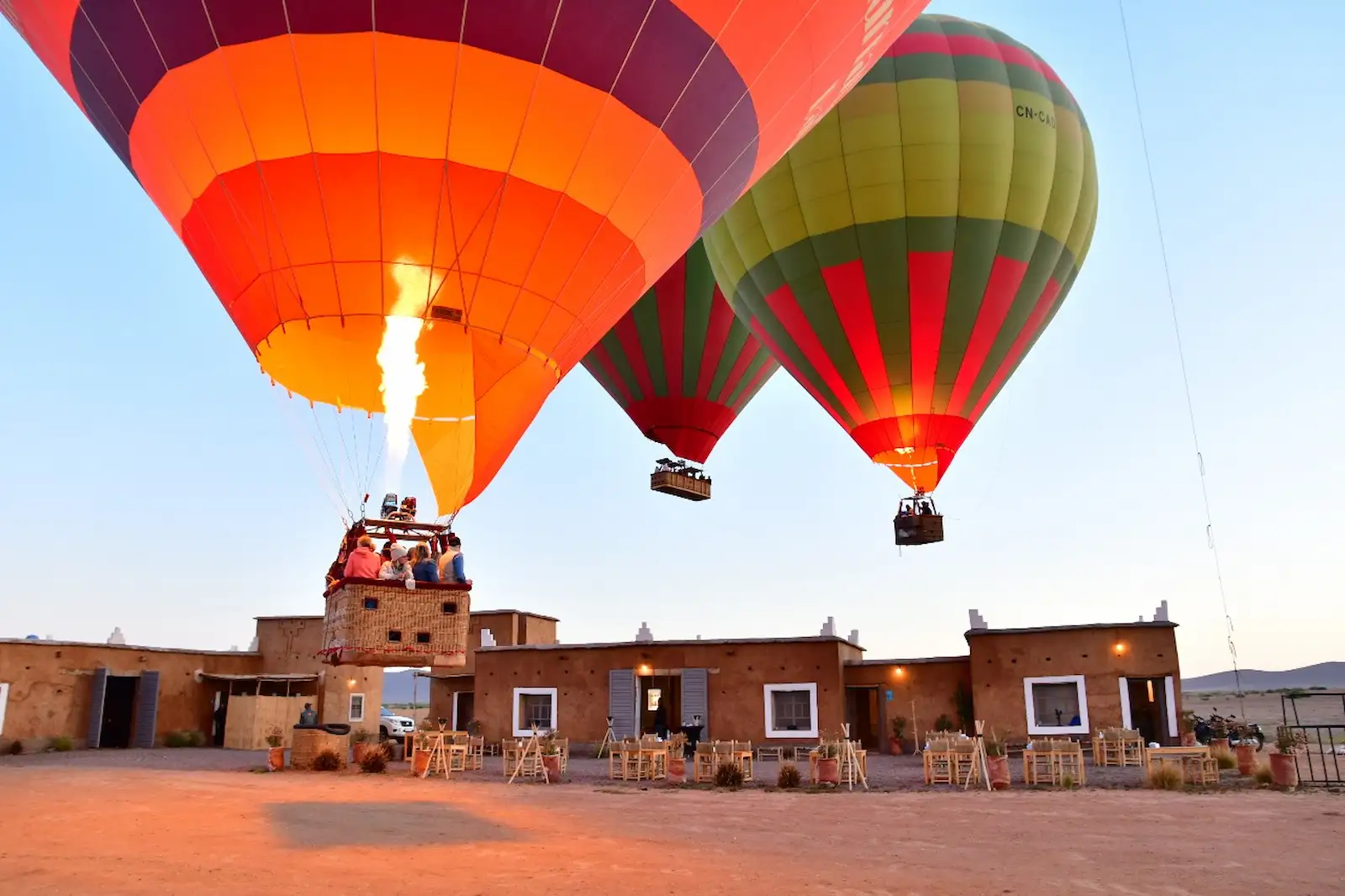
Several kilometers north-east of the centre, beyond the ring road, the city thins out into the Palmeraie — a historic palm grove said to date back to the Almoravid dynasty, where tens of thousands of date palms shade a landscape of walled estates, golf courses and resorts. This is Marrakech in a completely different register: not medieval intensity but space, greenery and quiet. You don't come to the Palmeraie to step out into the souk; you come to switch off.
Resorts & villas
The Palmeraie is built for resort holidays. Here you'll find sprawling hotels with multiple restaurants, spas and the largest swimming pools in the Marrakech area, alongside privately rented villas with their own pools and gardens — the kind of self-contained base that's hard to find inside the walls. Space is the headline luxury: lawns, palm shade, and room to spread out that the dense medina simply cannot offer.
Families & relaxation
For families, the Palmeraie is often the smartest choice. Children can swim and run safely in walled grounds; there's no traffic-choked alley to navigate; and renting a villa with a kitchen and a private pool can work out better value than several medina rooms. It's also a favourite of honeymooners wanting seclusion and repeat visitors who've already "done" the old city and now just want to relax, with day trips into Marrakech, hot-air balloon flights over the grove, or a round of golf on the doorstep.
Advantages
- Big swimming pools, gardens and genuine space
- Calm, green and quiet — the opposite of medina overload
- Villas with private pools and kitchens, great for families and groups
- Resort facilities: spas, golf, kids' clubs, multiple restaurants
- Easy parking and car access — ideal if you've hired a car
Disadvantages
- 15-25 minutes from the medina — you taxi for everything
- Transport costs add up over a week, and you need to plan rides
- You experience the resort, not the living city
- Isolating without a car if you like spontaneous wandering
Agdal — the quiet, modern new district
South of the medina walls, where the historic Agdal Gardens and the Royal Palace give way to the long, palm-lined Avenue Mohammed VI, lies the district most guidebooks skip: Agdal. This is the Marrakech of the last twenty years — wide modern boulevards, new apartment blocks, shopping malls, gyms and supermarkets — built for the city's growing middle class rather than for tourists. You won't find riads or souk theatre here, and that is precisely the point. Agdal is calm, contemporary and residential, and a certain kind of traveler loves it for exactly those reasons.
Newer developments & everyday comfort
Agdal and the neighbouring stretches along Avenue Mohammed VI are full of newer, well-built apartments and modern aparthotels — the sort with a lift, reliable hot water, full kitchens and underground parking that the old medina simply can't provide. It's home to the Menara Mall and the polished M Avenue promenade, with international shops, cinemas, chain cafes and easy supermarkets. For long-stay visitors, remote workers and anyone who wants to self-cater, the value is excellent: you get far more modern space for your money here than near the square, and life's practicalities — a pharmacy, a gym, a big grocery run — are all on the doorstep.
A quieter atmosphere
If the medina is a sensory firehose, Agdal is a long, calm exhale. There are no touts, no scooters squeezing past you in an alley, no haggling — just ordinary Moroccan city life going about its day. Streets are wide, lit and easy to walk; taxis pull up to your actual door; and you'll be staying among locals rather than other tourists. The trade-off is honesty itself: Agdal has very little of the romance or history that draws people to Marrakech in the first place, and it's a 15–20 minute taxi from Jemaa el-Fna. You stay here for comfort, value and quiet, not for atmosphere.
Advantages
- Modern apartments and aparthotels with lifts, kitchens and parking
- Excellent value — more space per euro than the centre
- Quiet, residential and hassle-free, with no touts
- Malls, gyms, supermarkets and cafes all within walking distance
- Great for long stays, remote workers and self-caterers
Disadvantages
- Little atmosphere — no riads, souks or historic character
- A 15-20 min taxi from the medina and main sights
- Spread out and modern; you could be in many growing cities
- Few classic "Marrakech" experiences on your doorstep
Compare the neighborhoods at a glance
One table to pull it all together — the four areas side by side, with the vibe, who they suit, how far they are from the old city, and the rough price level.
| Area | Vibe | Best for | Stay type | To the Medina | Price level |
|---|---|---|---|---|---|
| Medina | Historic, intense, atmospheric | First-timers, couples, budget, authenticity | Riads (every budget) | You're in it | € – €€€€€ |
| Gueliz | Modern, relaxed, European | Foodies, longer stays, returning visitors | Hotels & apartments | 10-15 min taxi | €€ – €€€ |
| Hivernage | Polished, upscale, nightlife | Luxury hotels, spas, partygoers | 5-star hotels | 5-10 min taxi | €€€ – €€€€€ |
| Palmeraie | Tranquil, green, resort | Families, honeymooners, relaxation | Resorts & villas | 15-25 min taxi | €€ – €€€€€ |
| Agdal | Modern, quiet, residential | Long stays, remote workers, value | Apartments & aparthotels | 15-20 min taxi | € – €€ |
Distances are approximate driving times to the medina by taxi. Price levels are relative within Marrakech and vary widely by season — expect spring and the Christmas/New Year period to be 20-40% higher.
Common mistakes tourists make choosing where to stay
After years of meeting travelers at the start and end of their trips, the same avoidable mistakes come up again and again. None are disasters, but each one quietly steals a little joy from a holiday. Here is the honest list.
- Booking on photos alone. A gorgeous courtyard tells you nothing about where the place actually is, how steep the stairs are, or how loud the alley gets. Always check the location on a map and read recent reviews before you fall in love with an image.
- Choosing the wrong neighborhood for the trip you want. Night owls who book a quiet medina riad and then taxi to Hivernage every evening; families who squeeze into a stair-filled riad when a Palmeraie villa would have been calmer and cheaper. Match the area to your priorities first.
- Staying outside the medina on a short first trip. If you have three or four nights and it's your first visit, basing yourself in Gueliz or the Palmeraie means spending precious time in taxis instead of in the old city you came to see.
- Booking right on Jemaa el-Fna and expecting silence. The square is magical, but it's also the loudest spot in the city until late. Stay a few minutes back in the southern medina if you're a light sleeper.
- Ignoring air conditioning in summer. June to September is genuinely hot, often above 38°C. A "cool traditional house" is not the same as a cool bedroom at 2 a.m. — confirm AC is in the room, not just the lounge.
- Underestimating the medina maze on arrival. Almost no first-timer finds their riad easily, even with Google Maps; the alleys are narrow, unmarked and unlit at night. Arrange to be met or transferred to the door rather than wandering with luggage.
- Assuming "riad pool" means a swimming pool. Most medina riad pools are small plunge pools for cooling off, not for swimming lengths. If real swimming matters, look to Hivernage or the Palmeraie, or a larger riad-hotel.
- Spreading yourself across the city. One area, well chosen, beats hopping hotels every two nights. You lose half a day each time you move, and Marrakech rewards settling in.
The arrival-night trap
The most common way a trip starts badly is the first night. The taxi can only reach a medina gate; from there your riad is on foot through alleys that are confusing jet-lagged and at night, and that is exactly when fake "guides" appear offering to lead you (for a tip, or to a shop). Have your riad arrange a meet-and-greet, or book a private airport transfer that walks you to the actual door. It is the cheapest insurance against a stressful start there is.
A Marrakech resident's recommendations
If you sat in my car on the way in from Menara airport and asked me where to stay, here is what I'd actually tell you — the unvarnished version, shaped by which kind of traveler you are.
If it's your first time, don't overthink it
Stay in the southern Medina, around Riad Zitoun or the Kasbah, and stop second-guessing. In years of meeting guests I have almost never had someone regret it. It's close enough to walk everywhere that matters, calm enough to sleep, and full of beautiful riads at every price. You came to Marrakech to walk out of your door into the old city — so do exactly that. Save Gueliz, Hivernage and the Palmeraie for a second visit or a specific need.
If you're bringing children
Be honest about their ages. With teenagers, a family-friendly riad in the medina is a wonderful adventure. With toddlers, the steep open stairs, unfenced fountains and plunge pools make a Palmeraie villa or a modern Gueliz hotel with a lift and a proper pool far less stressful — and often better value. There's no wrong answer here, only the one that fits your family's stage of life.
If you want luxury
Decide what luxury means to you. If it's a big pool, a spa, a gym and seamless service, book Hivernage or a Palmeraie resort. If it's craftsmanship, privacy and a sense of place — sleeping inside a restored palace where every tile was cut by hand — the top end of the Medina is unmatched, and quietly more special. The most memorable luxury stays in this city are behind plain medina doors.
If you're here for the nightlife
Base yourself in Hivernage. The clubs and bars are there, you can walk home, and Gueliz's wine bars are a short stroll away. A long taxi back to a far medina door at the end of every night gets old fast — stay where the night actually happens.
If you're watching your budget
The Medina is your friend, not your enemy. This is the surprise that delights every first-timer: you do not have to spend much to sleep somewhere beautiful here. A budget riad still gives you a tiled courtyard, a rooftop breakfast and hosts who treat you like family, often from around €35 a night — in the most exciting part of the whole city. Read recent reviews for cleanliness, confirm AC if you're travelling in summer, and you'll do wonderfully.
If you have a week or more, consider splitting your stay: a few nights in a medina riad to feel the old city, then a few in the Palmeraie or Hivernage to decompress by a big pool before you fly home. You get the best of both worlds, and ending on calm rather than chaos is the kindest thing you can do for yourself after days in the souks.
Wherever you land, the city itself opens up easily once you're settled — if you want to plan your days, our guide to the best things to do in Marrakech pairs naturally with whichever neighborhood you choose.
Frequently asked questions
Which area is best for first-time visitors?
The Medina, and specifically the calmer southern part around Riad Zitoun and the Kasbah. It's a short walk to Jemaa el-Fna, the souks and the main monuments, but quieter than the streets right on the square. Staying inside the old city is the whole point of a first trip to Marrakech — this corner gives you that immersion while still letting you sleep.
Medina or Gueliz — which should I choose?
Choose the Medina for atmosphere, riads, the souks and the monuments on your doorstep, especially on a first visit. Choose Gueliz, the modern new town, if you prefer wide pavements, great restaurants, cafe culture, licensed bars and a modern hotel with a lift and a full-size pool, and you don't mind a 10-15 minute taxi into the old city. Many people do both across a longer stay.
Is the Medina too noisy to sleep in?
Less than you'd fear. The alleys are lively, but riad bedrooms face an internal courtyard rather than the street, so they're surprisingly quiet. The exceptions are properties right beside Jemaa el-Fna, which hums until late, and any building next to a mosque, where the dawn call to prayer carries. If you sleep lightly, pick the southern Medina or Kasbah and ask for a room set back from the courtyard.
Is Gueliz walkable?
Yes — Gueliz is the most walkable district in Marrakech. It's laid out on a grid with wide pavements, pedestrian crossings and street lighting, so you can stroll between restaurants, cafes and shops the way you would in a European city. The one thing you can't easily walk is the distance to the Medina, which is a 25-35 minute walk or, more sensibly, a short taxi ride.
Which area is safest?
All four main areas are safe for visitors, including women and solo travelers; violent crime against tourists is rare. Gueliz and Hivernage feel the most orderly thanks to wide, lit streets and far less hassle. The Medina is also safe but more intense — expect touts, scooters in the alleys and the chance of getting lost rather than real danger. The single best safety move anywhere is arranging a transfer to your door on arrival night.
Where should I stay in Marrakech with family?
Two strong options. For space, a big pool and room for children to run, choose a villa-style riad or resort in the Palmeraie and taxi in for day trips. To stay nearer the action, pick a larger family-friendly riad in the southern Medina or a modern Gueliz hotel with a lift and pool. The Medina is magical with older kids; with toddlers, mind the steep stairs, open courtyards and plunge pools.
What are the luxury areas in Marrakech?
Luxury lives in three places. Hivernage has the city's international five-star hotels, spas and rooftop bars. The Palmeraie has palatial resorts and private villas with huge pools and gardens. And the Medina hides the most extraordinary stays of all — from the Royal Mansour to grand restored riads — where the luxury is craftsmanship, privacy and service rather than marble lobbies.
Where's the best area for nightlife?
Hivernage is the nightlife district, home to the biggest clubs, lounge bars and late-night restaurants, with Gueliz next door for wine bars and a more relaxed evening. The Medina is largely quiet and mostly dry after dinner, apart from rooftop restaurants and the nightly theatre of Jemaa el-Fna — so if you're a night owl, base yourself in Hivernage or Gueliz.
How many nights do I need in Marrakech?
Three to four nights is enough to enjoy the medina, the main monuments and a day trip; a week lets you add the Atlas, the Agafay desert or the coast and still relax by a pool. For a week or more, consider splitting your stay between a medina riad and a calmer Hivernage or Palmeraie base to balance immersion with rest.
Is the Palmeraie too far away?
It depends on how you plan to spend your days. The Palmeraie is a 15-25 minute taxi from the medina, so for a short, sightseeing-heavy first trip it can feel remote — you'll spend time and money shuttling in and out. But that distance is exactly why people choose it: if you want a big pool, garden space and resort calm, and you're happy to taxi in for day trips (or you've hired a car), it isn't too far at all. For families and relaxed second visits it's ideal; for a packed three-night first visit, stay closer to the old city.
Which neighborhood is best without a car?
The Medina, hands down. Everything iconic — the souks, Jemaa el-Fna, the palaces and museums — is within walking distance, so you barely need transport at all. Gueliz and Hivernage are the next best carless bases: both are walkable in themselves and a cheap, quick taxi from the old city. Avoid the Palmeraie and outer Agdal without a car, as you'll rely on taxis for every single outing, which is workable but adds up and needs planning. As a rule, the closer to the medina you stay, the less you'll miss having your own wheels.
Is it better to stay inside or outside the Medina?
For most first and second visits, stay inside the Medina — the old city is the reason you came and everything iconic is within walking distance. Stay outside, in Gueliz, Hivernage or the Palmeraie, if you specifically want modern comfort, a big pool, nightlife, accessibility or a calm resort base, and you're happy to taxi in for sightseeing.