
Staying connected in Morocco is cheap, easy and — for almost everyone — worth sorting out in the first hour of your trip. A local SIM card or a Morocco eSIM turns the country from a place where you're squinting at hotel Wi-Fi into one where you have maps, WhatsApp, ride-hailing and translation in your pocket everywhere you go. The good news: data here is genuinely inexpensive, the networks are better than many visitors expect, and buying a SIM as a tourist takes minutes. The slightly less good news is that the three operators are not equal, the airport kiosks love to oversell you, and coverage in the desert and the deep Atlas is not what the marketing maps promise. This guide is the honest version — what I'd tell a friend flying in tomorrow — covering which provider to choose, where the signal really reaches, what it costs, and the handful of mistakes that catch travellers out.
The quick answer
For most travellers, Maroc Telecom is the best overall SIM thanks to the widest national coverage, Orange is the fastest and strongest in the big cities, and Inwi is the cheapest if you're staying mostly urban. If you'd rather be online the second you land — no shop, no queue — buy a Morocco eSIM before you fly. Whatever you pick, you'll spend roughly €5–€20 for plenty of data, and you can top up in a minute when you run low.
The widest coverage in the country, including desert and mountain areas where rivals drop out. The safe default for almost any trip.
Excellent, fast 4G/5G across Marrakech, Casablanca, Rabat and Fes. The pick if you're city-hopping and want speed.
The cheapest data and frequent promos. Great value if you stay mostly in cities and watch your dirhams.
Buy online, scan a QR code, land connected. The most convenient choice — keeps your home number live too.

If your trip includes the Sahara, the Atlas, or long drives between cities, get Maroc Telecom — it's the network locals trust off the beaten track, and the one most of our drivers carry. If you're staying in Marrakech and the big cities and want the fastest data, Orange is brilliant. And if you simply don't want to deal with a shop on day one, install an eSIM at home the night before you fly. There's no wrong answer here, only the right one for your route.
Can Tourists Buy SIM Cards in Morocco?
Short answer: yes, absolutely — it's quick, cheap, legal, and one of the easiest things you'll do all trip.
Buying a prepaid SIM as a foreign visitor in Morocco is completely straightforward. There's no residency requirement and no special tourist permit — you just need your passport, because Moroccan law requires every SIM to be registered to an identity document. The shop assistant photographs or scans your passport, registers the SIM, pops it in your phone, and you're connected, usually within five minutes. Bring the actual passport rather than a photocopy; a copy is sometimes accepted but the original avoids any fuss.
You'll find SIMs sold in three kinds of places. First, the operator desks at the airport, open for arriving flights — the most convenient but usually the most expensive. Second, the official branded stores (Maroc Telecom, Orange and Inwi all have shops on the main streets of every city and in the big malls) — the best balance of fair price and proper help. Third, the countless small phone kiosks and téléboutiques dotted around every medina and neighbourhood, where a local SIM can be cheapest of all, though the English may be limited.
One small but important point: make sure your phone is unlocked before you travel. If your handset is still tied to a carrier back home, a Moroccan SIM won't work in it. Most modern phones bought outright are unlocked, but if yours came on a contract, ask your operator to unlock it before you fly — it's the single most common reason a traveller's new SIM refuses to connect.
The three networks at a glance
Morocco has exactly three mobile operators: Maroc Telecom (also called IAM, the historic national carrier), Orange Morocco (the former Méditel, now part of the global Orange group), and Inwi (the youngest and most price-aggressive of the three). Everything you'll be offered — every "tourist pack," kiosk SIM and eSIM — runs on one of these three networks.
Maroc Telecom vs Orange vs Inwi
Here's how the three networks stack up on the three things that actually matter to a traveller — coverage, speed and price.
| Provider | Coverage | Speed | Price |
|---|---|---|---|
| Maroc Telecom | |||
| Orange | |||
| Inwi |
The pattern is easy to remember. Maroc Telecom wins on reach: it has the most towers and the deepest rural footprint, so it's the one still showing bars when you're winding through the Atlas or approaching the dunes. Orange wins on speed in the places most tourists spend their time — the big cities, where its 4G and emerging 5G are genuinely fast. Inwi wins on price, with cheap data and constant promotions, at the cost of a thinner rural network. None of the three is a bad choice in a city; the differences only become decisive once you head into the wild.
Prices between the three are broadly similar for tourists — expect somewhere around 50–200 MAD (€5–€20) for a SIM loaded with a generous data bundle, the exact figure depending on how many gigabytes you take. Inwi tends to undercut, Maroc Telecom and Orange sit close together, and the airport always costs more than a city shop for the same thing.
The Three Networks in Detail
A closer look at each operator — who it's for, what it's good at, and where it falls short.
Maroc Telecom (IAM)
The historic national carrier and the network with by far the most extensive infrastructure in the country. If a remote village, a desert town or a mountain pass has any signal at all, it's most likely Maroc Telecom's. This is the network locals choose when reliability matters more than anything, and the one I recommend to anyone whose itinerary leaves the cities.
- Best for: road trips, the Sahara, the Atlas, anyone wanting one SIM that works everywhere.
- Strengths: unbeatable rural and desert coverage; strong, stable 4G; widest store network for help and top-ups.
- Watch out for: not always the cheapest, and not always the fastest in a head-to-head city speed test against Orange.
Orange Morocco
Part of the global Orange group and a favourite with younger Moroccans and expats. In the cities its data is excellent — frequently the fastest you'll measure — and it's at the front of the 5G rollout. If your trip is mostly Marrakech, Casablanca, Rabat, Tangier and Fes, Orange is a superb, snappy choice with plenty of well-staffed, English-friendly stores.
- Best for: city-based trips, remote workers, heavy streamers who want speed.
- Strengths: excellent urban 4G/5G; fast and consistent in tourist areas; good tourist data packs.
- Watch out for: rural coverage is good but a step behind Maroc Telecom once you're well off the main roads.
Inwi
The youngest of the three and the one that competes hardest on price. Inwi is popular with budget-conscious locals and students, with cheap bundles and regular promotions. In Marrakech and the other big cities it performs perfectly well; the trade-off is a less developed network once you head into the countryside, mountains or desert.
- Best for: tight budgets, short city breaks, second SIMs for extra data.
- Strengths: the cheapest data and frequent promos; solid urban performance.
- Watch out for: the weakest rural and remote coverage of the three — not the one for a desert trip.
Buying a SIM Card at the Airport
Convenient, yes — but you'll pay for that convenience, and the kiosks have a habit of selling you more than you need.
At Marrakech Menara, Casablanca Mohammed V, and the other main international airports you'll find operator desks — usually Maroc Telecom and Orange, sometimes Inwi — positioned right around arrivals, often before or just after baggage. They're open for incoming flights, the staff speak enough English and French to get you sorted, and you can walk out of the terminal already connected. For a lot of travellers that peace of mind, after a long flight, is worth a few extra euros.
And it usually is only a few extra euros. Expect an airport tourist SIM to run somewhere around 100–200 MAD (€10–€20) for a pack with a chunk of data and sometimes a little call credit. The same SIM and bundle from a city-centre store can be noticeably cheaper, and a neighbourhood kiosk cheaper still — but you're trading immediacy for the saving. If you value your time and arrive late or tired, the airport desk is a perfectly reasonable choice; just know you're paying a small convenience premium.
Two things keep you out of trouble. First, decline the biggest bundle — the staff are incentivised to upsell a 30 GB or 50 GB "tourist" pack you'll never finish; a 10–20 GB option is plenty for most trips, and you can top up in a minute if you run low. Second, ask them to test the data before you walk away — open a map or load a page while you're standing there, so any registration hiccup is fixed on the spot rather than discovered in your taxi.
Morocco eSIM Options
If your phone supports it, an eSIM is the most painless way to arrive connected — no shop, no queue, no passport registration.
An eSIM is a digital SIM your phone downloads instead of a physical card. For Morocco it has become the favourite option for a lot of travellers, and it's easy to see why: you buy a plan online before you fly, scan a QR code to install it, and the moment your plane lands and you switch off airplane mode, you have working mobile data. No hunting for a desk, no language barrier, no handing over your passport. Just as importantly, an eSIM sits alongside your normal SIM, so your home number stays active for any calls or bank texts while your Moroccan data runs in the background.
The main international eSIM providers — Airalo, Holafly, Saily and similar — all sell Morocco plans, and behind the scenes they run on one of the three local networks (often Maroc Telecom or Orange), so coverage is essentially the same as a local SIM. The trade-off is cost: per gigabyte, an eSIM is usually a little more expensive than buying local, and the very cheapest options are data-only with no Moroccan phone number. For most visitors that's a non-issue — almost everything runs over WhatsApp and data anyway.
Does my phone support eSIM?
Most phones from the last few years do — iPhone XS/XR and newer, recent Google Pixels, and flagship Samsung Galaxy models among them. Check your settings for an "Add eSIM" or "Add cellular plan" option, and make sure the handset is carrier-unlocked. If your phone is older or eSIM isn't there, no problem — a physical local SIM does exactly the same job.
So: eSIM or physical SIM? Choose an eSIM for convenience and to keep your home number live — ideal if you want zero hassle on arrival and don't mind paying slightly more. Choose a physical local SIM for the lowest price and a real Moroccan number, and if you're happy to spend five minutes at a shop. Both give you the same fast data once you're up and running.
Coverage City by City & Region
The single most useful thing to understand: Morocco's cities are excellently covered, but the desert and the high mountains are not the seamless blanket the network maps suggest. Here's the realistic picture.
Marrakech
Strong, fast 4G across the whole city — medina, Gueliz, the Palmeraie — with 5G emerging. All three networks perform well; data drops only in the very deepest souk lanes, and only briefly.
Fes
Reliable coverage throughout the new city and the ancient medina. The dense, tall-walled lanes of Fes el-Bali can briefly mute the signal, but you're never far from solid data again.
Casablanca
The country's best-connected city and the front line of the 5G rollout. Fast, dense coverage everywhere — Casablanca and Rabat are where speeds are highest and most consistent.
Sahara Desert
Usable around the desert towns and many camps near Merzouga and Zagora — best on Maroc Telecom — but expect to lose signal entirely among the dunes and on remote pistes. Plan to be off-grid for a night.
Atlas Mountains
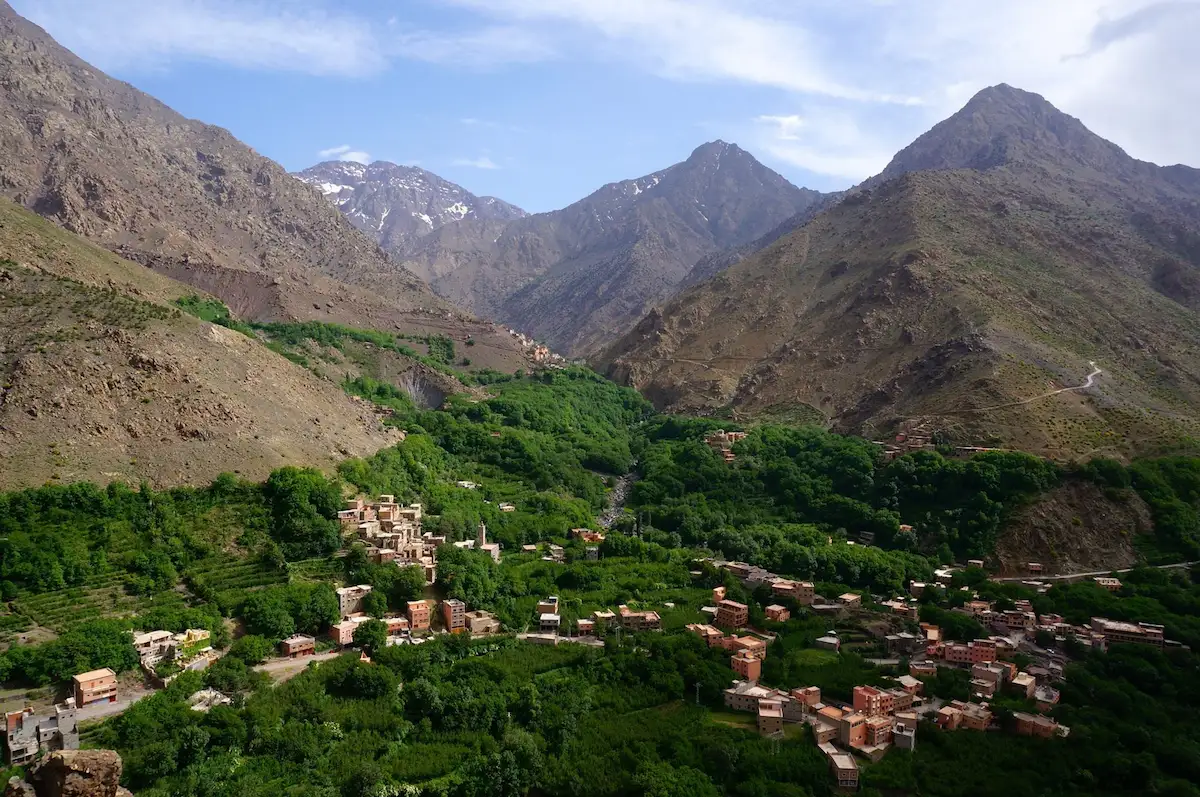
Good in the valley towns and along the main passes, but it comes and goes with the terrain — a village can have signal while the valley below it has none. Maroc Telecom reaches furthest up here.
Coastal Regions
Essaouira, Agadir, Tangier and the developed coast are well covered with fast data. Quieter beaches and stretches between towns can dip, but day to day the coast is reliably connected.
The headline lesson runs through all of it: do not assume mountain and desert coverage is perfect. Network maps are optimistic, and "covered on the map" can mean a single bar that won't load a photo. Wherever you're heading off the main roads — the Sahara especially — download your route in Google Maps offline before you set out, save any addresses or confirmations you'll need, and treat any signal you do get as a bonus. If you're travelling with a private driver or guide, they'll have a local SIM and know exactly where the dead zones are.
What Locals Actually Use
Forget the marketing — here's what people who live here actually carry, and why.
Among Moroccans, all three networks have their loyalists, but the rule of thumb is simple and it mirrors the advice above. Maroc Telecom is the network people trust for reliability, particularly anyone who travels around the country, works in rural areas, or simply wants the safest bet for signal everywhere. It's the grown-up, dependable choice, and it's what a lot of taxi drivers, guides and rural families use precisely because it works where the others don't. If you ask a Moroccan "which network actually has signal in the bled (the countryside)?", the answer is almost always Maroc Telecom.
Orange and Inwi are hugely popular in the cities, especially with younger people, students and anyone chasing the best price-to-data ratio. Orange has a strong following for fast urban data and its app; Inwi wins fans with cheap bundles and aggressive promotions. Plenty of locals even keep a second SIM or a cheap dual-SIM phone to play the promos off each other. But when that same city dweller plans a trip to the desert or their home village in the mountains, they'll often switch to — or borrow — a Maroc Telecom line for the journey.
I keep Maroc Telecom as my main line for exactly this reason — it's the one that doesn't let me down when I'm driving guests over the Atlas or out to Merzouga, and that reliability is worth more to me than saving a few dirhams. For a visitor I'd put it like this: if your trip touches the desert or the mountains at all, Maroc Telecom for the best remote coverage is the call. If you're staying in the cities, take whichever is cheapest or fastest — you genuinely can't go wrong.
Common Mistakes to Avoid
The handful of things that trip travellers up — and how to sidestep each one.
Buying too much data
The airport upsell of a giant 30–50 GB "tourist" bundle is the classic trap. With Wi-Fi in most riads and cafés, the average traveller burns through far less than they fear and leaves gigabytes unused when the SIM expires.
Do this instead: start with 10–20 GB and top up in a minute if you run low — local data is cheap and easy to add.Relying on airport & hotel Wi-Fi
Public and hotel Wi-Fi in Morocco is hit-and-miss — fine in the lobby, frustrating in your room, useless the moment you step outside to find your riad in a maze of unmarked lanes. Counting on it to navigate or call a ride is a recipe for stress.
Do this instead: get a SIM or eSIM sorted on day one so you have your own data for maps and WhatsApp everywhere.Assuming mountain & desert signal is perfect
Coverage maps imply a seamless blanket; reality is dead zones in the dunes, the gorges and the high passes. Travellers who assume constant signal get caught out with no offline map and no way to reach their accommodation.
Do this instead: download offline maps and save key addresses before you leave the city, and choose Maroc Telecom for the best remote reach.A couple of smaller ones worth a mention: forgetting to unlock your phone before you travel (a locked handset won't take a Moroccan SIM), and leaning on your home SIM's roaming without checking the rate — Morocco sits outside the EU, so roaming can be eye-wateringly expensive. Sort both before you fly and the rest is plain sailing.
Staying connected across Morocco





Frequently Asked Questions
Can tourists buy SIM cards in Morocco?
Yes. Any visitor can buy a prepaid SIM — it's quick, cheap and legal. You just need your passport for registration, which is required by law. SIMs are sold at the airport, in the official Maroc Telecom, Orange and Inwi shops in every city, and at thousands of small phone kiosks. A tourist data SIM typically costs 50–200 MAD (roughly €5–€20) depending on how much data you choose.
Which is the best SIM card in Morocco?
For most travellers, Maroc Telecom is the best overall because it has the widest national coverage, including remote desert and mountain areas. Orange is excellent and often fastest in the cities, while Inwi is the cheapest and fine for urban stays. If you want to land already connected, a Morocco eSIM bought before you arrive is the most convenient option of all.
Can I use my European SIM card in Morocco?
You can, but you usually shouldn't. Morocco is outside the EU, so the "roam like at home" rules don't apply and roaming charges can be very high unless you have a specific travel add-on. Check your operator's Morocco rates before you travel. For anything beyond emergency use, a local SIM or a Morocco eSIM will be dramatically cheaper.
Is 5G available in Morocco?
5G is rolling out across the major cities through 2026, with all three operators deploying networks ahead of Morocco co-hosting the 2030 World Cup. Coverage is concentrated in and around Casablanca, Rabat, Marrakech and other large cities for now. Everywhere else, fast and reliable 4G/LTE is what you'll use day to day — and it's more than enough for maps, streaming and video calls.
Can I top up my Moroccan SIM online?
Yes. You can recharge through each operator's app — My Maroc Telecom, My Orange and Inwi — using a card, or buy a paper recharge voucher from any kiosk or grocery and enter the code. Data passes are activated by a short code or in the app. The whole thing takes a minute and you can do it as often as you like during your stay.
Does WhatsApp calling work in Morocco?
Yes. WhatsApp messaging, voice and video calls all work normally over mobile data and Wi-Fi in 2026. There was a period years ago when VoIP calling was restricted, but that's no longer the case for everyday use. WhatsApp is how most Moroccans, riads, guides and drivers — including our team — will stay in touch with you.
How much mobile data do I need for a trip to Morocco?
Most travellers get by comfortably on 10–20 GB for a one- to two-week trip, covering daily maps, messaging, social media and the odd video call — especially since most riads and cafés have Wi-Fi. Heavy streamers might want more. Don't over-buy a giant bundle on arrival; local data is cheap and you can top up in a minute if you run low.
Will I have phone signal in the Sahara desert?
Often, but not everywhere. Around the desert towns and most established camps near Merzouga and Zagora you'll usually have a Maroc Telecom signal. Out among the dunes and on remote pistes, expect to lose service entirely — and honestly, that's part of the magic. Download your maps offline, tell people you'll be off-grid for a night, and enjoy the disconnection.
Do I need to register a SIM card with my passport?
Yes — Moroccan law requires every SIM to be registered to an identity document, so you'll need your passport when you buy one. The shop handles it in a couple of minutes. Bring the original passport rather than just a photocopy to avoid any hold-up. An eSIM bought online skips this step entirely.
eSIM or physical SIM — which should I get?
Choose an eSIM for maximum convenience and to keep your home number active — perfect if you want zero hassle on arrival and don't mind paying slightly more per gigabyte. Choose a physical local SIM for the lowest price and a real Moroccan number, if you're happy to spend five minutes at a shop. Both deliver the same fast data once set up.